



How did hitting a little white ball become so complicated? Once, golfers worried about keeping their head down, buying a new driver and having enough balls to finish the round. Now, thanks to modern golf technology, we discuss spin loft, dynamic lie, attack angle and ground reaction forces. We even debate whether our driver shaft has been tipped half an inch.
Welcome to modern golf, where everyone has become a scientist.
When Golf Was a Simple Game
It used to be a simple game. You carried fourteen clubs, although you only trusted about six of them. You had a rough sense of how far your 7-iron went. In fact, the most sophisticated piece of technology in your bag was a pencil.
If you hit your driver badly, somebody told you that you’d lifted your head. Slice, top or hook, it didn’t matter what the real problem was. Golf instruction had been completed.
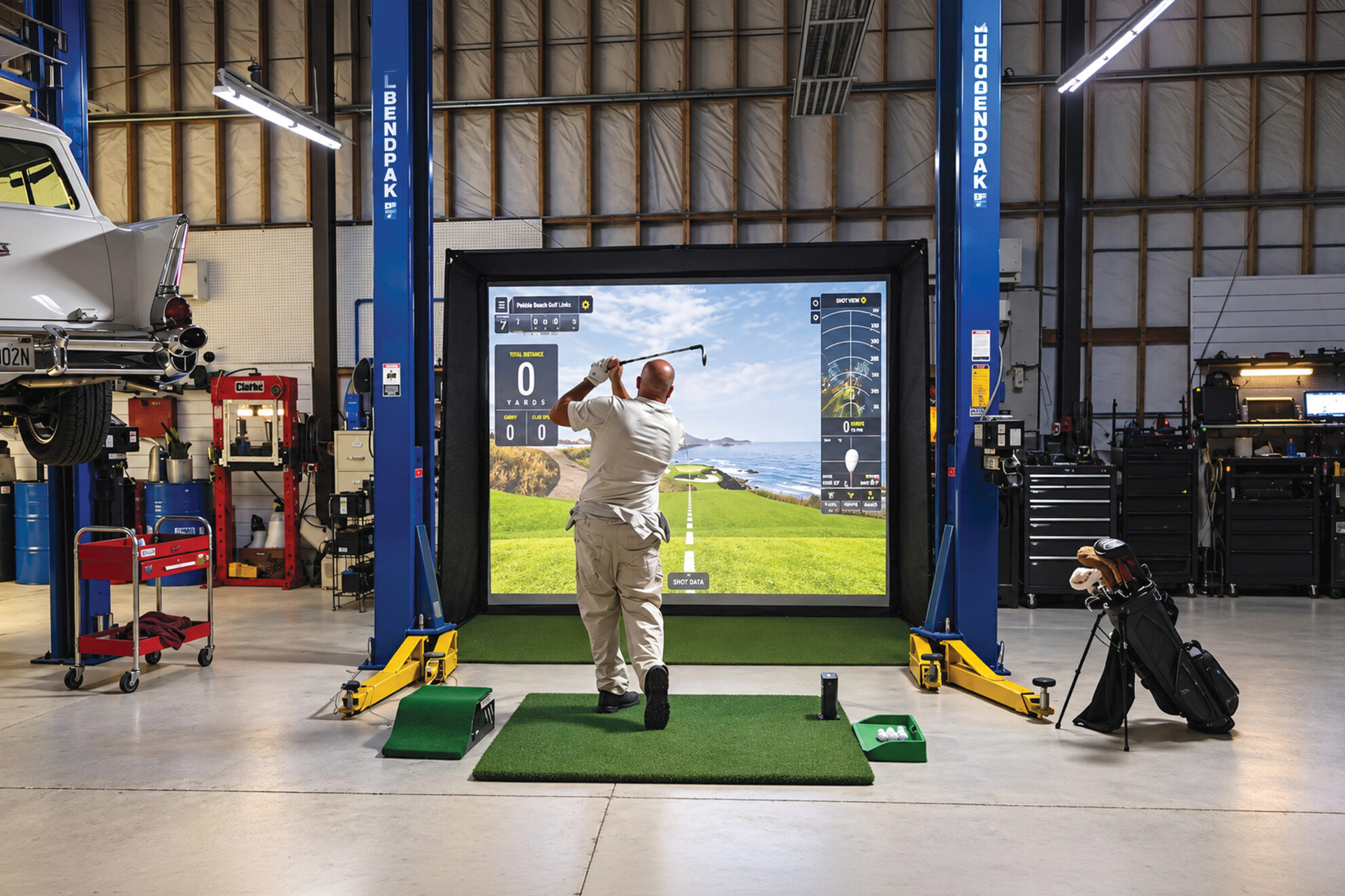
Today, the modern golfer walks onto the range with a $600 driver and a $500 GPS watch. Then he places a $20,000 launch monitor behind a bucket of balls and announces that his spin loft is a little high. Dave, a 17-handicap accountant, is worried. His dynamic loft is 16.2 degrees and his smash factor has dropped to 1.43. Dave has hit three balls.
Welcome to the age of the Golf Nerd.

Launch Monitors: The Golf Technology That Gave Us the Numbers
Launch monitors have done more than anything else to change the language of golf. TrackMan, Foresight, FlightScope and their cheaper rivals give ordinary golfers data once reserved for tour professionals and club fitters. That includes club speed, ball speed, launch angle, spin rate, carry, attack angle, club path, face angle, dynamic loft, spin axis and low point.
As a result, one terrible drive now produces enough data to launch a criminal investigation. And that’s the wonderful thing about golfers. Give us a number and we immediately want to improve it. Ball speed, spin rate, carry distance: suddenly you’re no longer practising golf, you’re trading derivatives.
The $5,000 Extra Yard
Nothing shows our relationship with golf technology better than our obsession with distance. Manufacturers spend millions developing lighter crowns and faster faces. Meanwhile, we happily spend hundreds of dollars on the latest driver because testing suggests it might add four yards. That works out at roughly $150 a yard.
The frightening thing is that modern fitting can genuinely work. Change the loft, shaft or head, and a golfer really can tighten dispersion. Unfortunately, this has also convinced golfers that a magical head and shaft combination exists somewhere that will fix their swing.
So they spend three hours trying combinations. Eventually, the ball travels exactly the same distance and finishes thirty yards right. Yet they’re delighted, because the spin dropped by 180rpm.
Regular or Stiff? Choosing a Driver Shaft
Buying a shaft now resembles an engineering degree. First there’s weight, then torque, kick point, bend profile and tipping. Before long, someone mentions PUREing or spine alignment. Suddenly you’ve spent $450 on a shaft for a driver that already cost $600.
There are players who know the exact swing weight of every club in their bag. However, they couldn’t tell you whether they can clear the bunker.
Your 7-Iron Is Lying to You
Distance has become a fresh source of confusion. Once, if someone asked how far you hit a 7-iron, you’d say “about 150.” That meant anywhere from 135 to 165, depending on conditions and how generous you felt.
Now we demand precision to the yard, even as the next five shots carry five different distances. Modern lofts haven’t helped either. Many modern 7-irons carry the loft of an older 6-iron. This produces one of retail’s great moments of false triumph, when a golfer marvels at hitting the “same” club twelve yards farther.
Force Plates: Then We Discovered the Ground
Force plates now measure how players push into the turf and how pressure shifts between their feet. It’s fascinating science. However, it has also handed amateurs a new set of numbers to fret over. After all, a mid-handicapper at the monthly Stableford is not exactly launching a rocket.
At the elite level, tour players use force plates and 3D motion capture to understand movement in genuinely useful detail. Consequently, “keep your head down” is finally under threat after a very long run.
Notably, not every top coach has embraced the machines. Butch Harmon, widely considered one of the best golf teachers today, has said he does not use these devices. Instead, he trusts ball flight to tell him everything he needs to know. It’s a reminder that data isn’t the only route to a good lesson.
Speed, Speed and More Speed
For decades, golf told players to swing smoothly. Now amateurs stand in garages swinging weighted sticks as hard as possible. They celebrate personal bests on a whiteboard. Why? Because distance offers something golf rarely does: a number that goes up. By contrast, handicaps are complicated and course management is boring.
Shot Tracking: We’re Tracking Everything
On-course tracking systems complete the picture. They let golfers see exactly where they gain or lose shots. Unfortunately, the data often tells us things we’d rather not know.
For example, you believed your putting was costing you shots. The data says it’s your approach play. Specifically, it’s the 8-iron you loved and trusted, which is now exiled to the garage.
YouTube University
YouTube isn’t strictly golf technology, but it has only added to the noise. It offers endless free instruction that contradicts itself from one video to the next. As a result, a golfer can rebuild his swing six times before lunch without leaving the sofa. Then he shanks the first ball at the range.
Has Golf Technology Actually Made Us Better?
Here’s the uncomfortable part. For all the sensors, apps and $20,000 simulators, the evidence that the average golfer is improving is thin. Despite decades of high-tech instruction, average handicaps have not meaningfully improved, according to one long-standing teaching body’s own assessment. That’s a fairly damning scoreboard for an industry built on the promise of measurable progress.
To be fair, golf technology has delivered real gains. Launch monitors have removed guesswork from fitting. GPS devices give accurate distances, and shot tracking can expose genuine weaknesses. Equipment, information and fitting are all better than they used to be.
The danger isn’t the technology. Rather, it’s believing that more information must always produce better golf. Sometimes a golfer doesn’t need another number. They need to hit the green. Knowing your 7-iron launches at 18.4 degrees with 5,800rpm of spin may matter less than knowing to aim twenty feet left of a tucked pin.
Why We Still Love the Game
Perhaps that’s where golf’s next revolution will happen. It won’t come from collecting more data, but from understanding which data actually matters. After all, the game remains gloriously resistant to perfection.
You can optimise your launch, MOI-match your irons and gap your wedges to the yard. You can also measure your pressure trace and track every shot. Then you walk onto the first tee, put a five-dollar ball on a wooden peg, and have absolutely no idea where it’s going.
And perhaps that’s exactly why we love it. For all the science and the growing pile of numbers, golf still delivers one beautifully simple truth: eventually, you still have to hit the bloody thing.